

I recently met Jakub Szczęsny, the architect and co-concept guru of FARM/SCHOOL (micro) and the enveloping Wilder Ridge: how to design a future-proof community in the mountains? (macro) project in Kampala, Uganda for the 32° East artist residency.
FARM/SCHOOL is a conceptual project on homecoming that combines locative narrative with land art. Jakub is a primary collaborator, and we hadn’t seen each other in person since 2019, and needed an intense work week. With the survey maps and 3D models available, we advanced a project in rural middle Tennessee from east Africa.
I presently live in São Paulo, having finished a site-specific project at a lunch counter (or lanchonete) in the center of the city in the same Modernist building compound. I do not only make site-specific works; however it is a common theme between São Paulo and Tennessee. There is some understanding between the two points. And, now they both seem like home.
Luiz Inácio Lula da Silva won his fourth (non-consecutive) term on Sunday, October 25th. As a student of political science and social justice movements, a collective global sigh of relief seemed mixed with the cacophony of car horns, fireworks and a revving motorcycle with its wheel disconnected from the motor I could hear from the 20th floor of Conjunto Santos Dumont. I recently helped the 40-year bartender buy the bar (or lanchonete) that was the focus of the project, and yesterday was his client for the first time outside the framework of the art project—let’s say—when his son (a new co-owner of the bar) told me that his dad, Tarcísio had been running in the street with a Lula flag on Sunday dodging water balloons. A neighborhood friend walked up for our lunch meeting and started telling Tarcísio about her kidney surgery. Tarcísio knows the artist, Bea Souza because she regularly volunteered for Lanchonete(.)org events and uses the shops in the three-building compound’s arcade. I realized as we walked away that I could always feel safe at Conjunto Santos Dumont even while I may be seen as the crazy, gringo artist. ‘Oi Gringo’ said the young girl—always in football attire—sitting in the elevator and holding the door with her foot as I came back in from the rain.
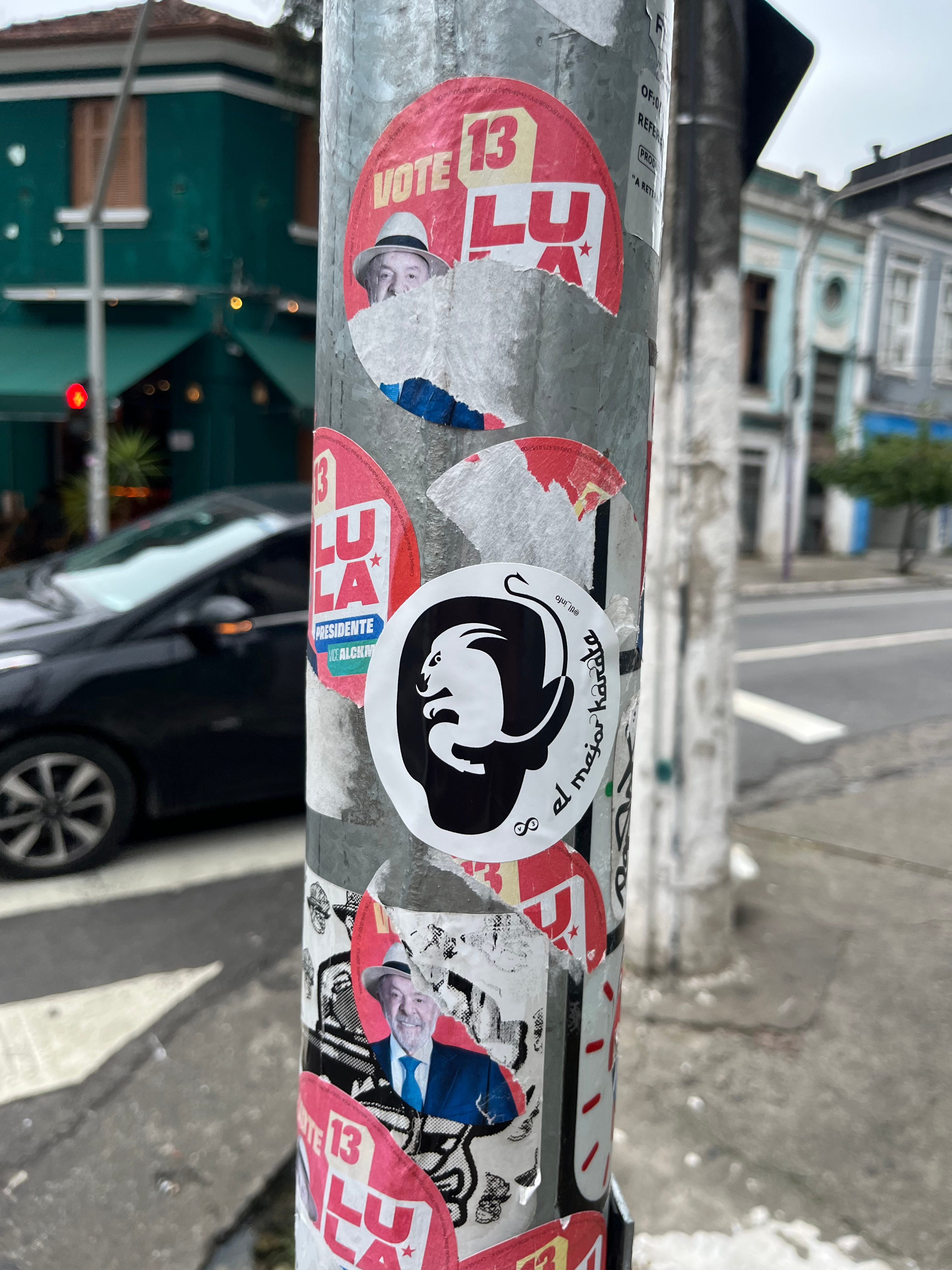
On the way to lunch, I tagged a pole with a single sticker. Bea is a friend. Her support during Lanchonete(.)org was powerful in that she saw the project on facebook and volunteered with a common vision that Conjunto Santos Dumont had been overlooked for its unique ecosystem in the midst of such a huge city: Art might be useful. She work with paper, and I came up with an idea to wheat paste a work of art together—specifically the 9 panels of the el mejor karate page—before I leave São Paulo. Bea is recovering from kidney surgery and yesterday we walked to a lunch spot across from a vacant wall. She is still worried about the police. I’m using her advanced age to game any encounter with authorities. No one will stop us if we decide to put up some graffiti. In Kampala I experimented with stencil. This blog is an experiment in graffiti. But maybe, just maybe a sticker is all I need. In I take eggs: a small graffiti manifesto, I speak to the freedom of a small and portable form.
While in Kampala, Jakub decided to have his architecture class—starting in October—focus on f/s and Wilder Ridge, building three scenarios for the project. After Uganda, I visited Tennessee to stake four spots for geotechnical investigation (e.g. rock depth, expanding v. shrinking soil); meet neighbors; and fix the horse pasture fence. I walked around the property—five miles or so—in both directions with my dad’s new dog, Turbo. Even before I landed, I knew I would perform such a walk.
This year, I’ve produced (and/or performed) three minor acts—a concert in Albania, cabaret in Brazil, and bazaar in Uganda—that may dialogue with three longer works, i.e. freeDimensional, Lanchonete(.)org and Luv ‘til it Hurts.
In #3 I want to say more about performance and methodology. In a 2019 Economy & Society Summer School by the University College of Cork, I was exposed to some of the academic literature on walking as methodology, and more recently the work of Tim Cresswell on place via another Summer School in Croatia.